Tuesday, June 16, 2015

Create a Character Confessional Using Storyboard That

This year I tried a lot of new things: using EngageNY modules, teaching Shakespeare to middle school students, and testing out the web tool Storyboard That. All three of these new experiments came together for me in a performance task for an end-of-the-year unit.

I wanted to expose my 8th grade students to Shakespeare before they reached high school. I decided that the play A Midsummer Night's Dream would be a good choice. It has an engaging plot, a lot of humor, and sets students up to successfully read Romeo and Juliet in 9th grade. Fortunately, EngageNY has a module that focuses on this play, so I didn't have to come up with daily lesson plans. As the unit came to a close, the students were supposed to complete one final performance task: a Character Confessional. Here is the explanation from the EngageNY unit overview:

In this third unit, and after studying the thematic concept of control throughout A Midsummer Night’s Dream, students will write a narrative that will act as a “confessional,” where a character from the play explains his or her attempts to control or manipulate someone else in the play. 

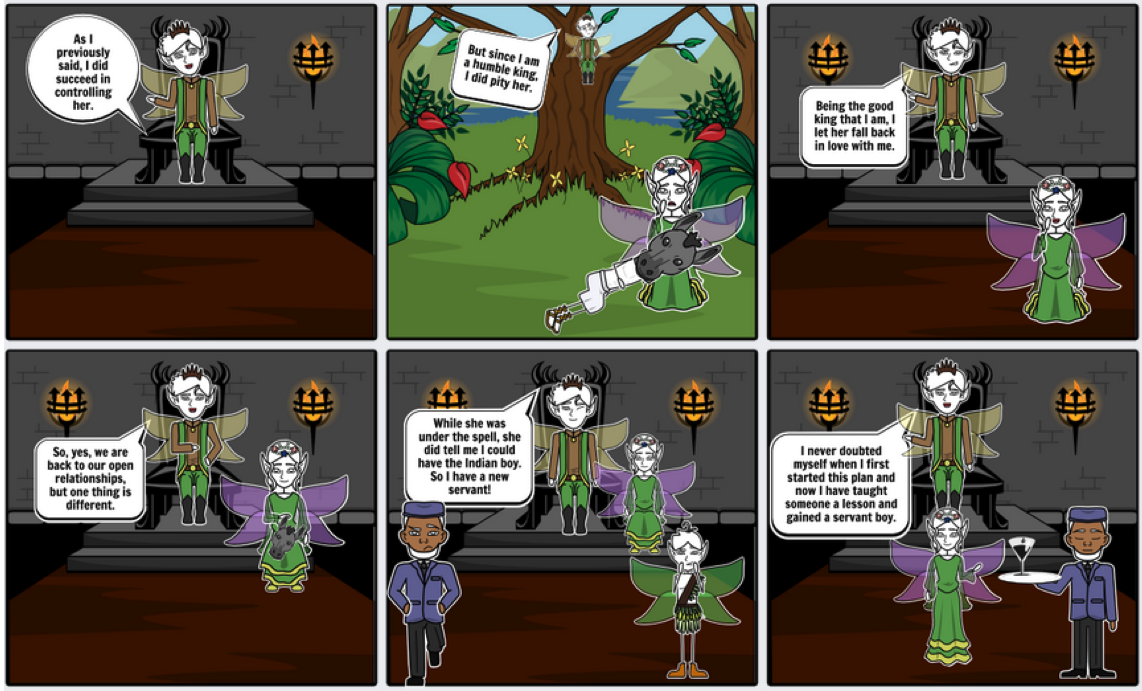
A sample narrative Character Confessional can be found here. Since it was one of our final assignments of the year, I decided that the students didn't need to complete another long form piece of writing. Instead, I swapped out the narrative with a comic. A colleague reminded me of how easy it is to create comics using the website StoryboardThat, so students used this tool to create their performance tasks. The original narrative assignment had three parts, so I had students create three sets of six-cell comics for this assignment. The students still had to write in the first person, but they could include various characters and sets from the play. Here is an example of a finished product.


What makes Storyboard That such an excellent tool is the large library they have of characters, scenes, and objects. Students really seemed to enjoy this performance task and it really demonstrated their understanding of a complex theme in this complex and comical play.

Wednesday, May 13, 2015

Tracking Student Projects Using Trello

When students are working on long or short term projects, it is important for the teacher and the students to be able to easily track group progress. Trello does this in a very visual and drag-and-drop fashion. Signing up for Trello is easy, especially if you use the Google sign-in option. 

The website uses the metaphor of a board where users create lists and cards. Each list can have multiple cards and users assigned to each card. Once the teacher creates a board and lists, students can easily be searched for and added to the board.

Trello board for my students' screencasting project.


Currently, my students are working on a video project with multiple steps. I have created a board for the project and a list for each step along the way. After adding my students to the board, they each create a card with explains where they are at on that step and who is in their group. When a group finishes a step in the project they simply drag their card to the next list, which is also the next step in the project. When I login to Trello I am able to see at a glance where each group is at and which groups may need my help to get to the next step.

Before using Trello I would walk around to each group and ask for a status update. This process could be time-consuming and frequently I would get stuck helping one group, only to discover another group needed my attention. Trello boards for each project let me see at a glance track student and group progress and intervene when and where necessary.

Here is a video explaining the basics about how to setup Trello from the Youtube channel InfoSharer.

Monday, February 23, 2015

Gallery "Walk" Using Google Slides and Padlet


I am currently trying one of Engage NY's ELA modules in my English class. In order to build background for the novel for the unit, the module has the students complete a Gallery Walk with primary sources. The sources range from poetry, to images, to quotes from historical figures.
I decided to digitize this process and brainstormed the best solution. I needed to recreate the sticky note aspect of a gallery walk, but also keep all of the student comments organized. I thought about putting the primary sources on a Google Doc and then having students add comments, but this would create too many comments in the margin since each student had to comment on each source.


I decided instead to put each primary source on a Google Slide and create a link to a Padlet wall for that slide. Students spent time reading and observing each slide for the gallery walk, and then clicking on the link to add to the padlet wall for the slide. Students were able to add their comments about the slide and interact with other student ideas. The Padlet wall functioned as the sticky notes for each artifact.

I staggered which slide each student started on in order to cut down on the number of students adding to a Padlet wall at the same time. Once each student had contributed a comment for each artifact  of the digital gallery walk, I put students in groups in order to summarize the comments for each slide.


Using Google Slides and Padlet for the gallery walk had a couple of advantages. First, the gallery walk now had a permanent digital home. Students could access the artifacts and comments at a later date. Padlet allows the creator of the wall to make it "View Only," therefore students can access the artifacts and comments at a later date. Second, this activity could be used in a flipped classroom model. Students could complete the Galley Walk at home and then the discussion of the artifacts could happen in class.

This process would never replace all Gallery Walks in class. But when you need one that students can complete in the cloud, this process seemed to work. 


Thursday, August 21, 2014

Google Classroom

As the new school begins you may be looking for ways to use Google Drive with your students. Recently Google created a new tool called Google Classroom and made it available to all GAFE accounts. This tool allows teachers to use Google Drive to distribute, collect, and grade assignments using Google tools. If you have ever used Drive before with students, you know that it can be a bit tricky to set up efficiently, especially for non-tech-savvy teachers. Google Classroom makes this much easier and I think it will be very appealing to many teachers. Thankfully Google has made available a lot of tools to help with the setup and use of Google classroom. Below is a link to the help section.

Google Classroom Help

Google has also included a short video that explains the basics of classroom.


In addition many teachers have created walkthroughs. Roger Nixon created the video below that shows the teacher and student view side-by-side.


Finally, Google made the image below that walks you through 10 best practices when using Drive.


Wednesday, April 23, 2014

Digital Research Part 2: Instagrok


Instagrok is a research tool that allows students to search trusted websites and provides search results in a visual format. Students can view the websites within Instagrok and star the ones that fit their topic. This web tool also provides a work space for students to begin paraphrasing and analyzing the sources they have chosen.

Students do not need an account to begin using Instagrok, but signing in allows a student to save her work from session to session. If a student already has a Google account, the student can sign in using this account. The opening page has a search box where students can enter a question or the topic they are researching. The results are presented in a visual web of terms and ideas related to their topic. Students can click on any part of the web to begin exploring websites which open up within Instagrok.


If a website provides information that the student is looking for, the student can press the green pin to save website for view later. Instagrok also helps students learn how to evaluate a website. Below each webpage is a "Is this site credible?" button. When students click on the button, they are taken to a list of questions provided by Easybib that help them evaluate the website. The teacher can then choose which questions they want their students to answer about a resource.


All of the websites students pin are saved to a journal. Students can then begin paraphrasing the material to help write the report. Since students have signed in using Google or created an account, the information is saved. This allows students to easily access their information later.

Instagrok is great for elementary or middle school students conducting research reports. It can also be used with early high school students who made need extra support researching a topic. Instagrok can be used via the web or can be downloaded as an app for iOS or Android.

Thursday, April 3, 2014

Digital Research Part 1: Teacher Guided

At a recent Edcamp, I facilitated a discussion about student research online. At the beginning of the session all of the teachers agreed that students have poor research skills. In addition, teachers felt unsure how to help students develop the research skills they needed. Based on the ensuing discussion at the Edcamp and input from other teachers, I think there are at least three ways to help students effectively conduct research online. In this first post I will focus on teacher guided research strategies.

#1 Link List

Perhaps the most basic method is creating a list of links for students to click through. This could be as simple as creating a list of hyperlinks on a Google document. Or it could be something more visually appealing like creating a Blendspace lesson. This website allows a teacher to drag-and-drop resources onto a grid that can be shared with students via a shortened url. Students can then proceed through the lesson one step at a time. I have included a link to video tutorial on how to use Blendspace.


#2 Google Custom Search

Another option is for a teacher to create a Google Custom Search Engine.  This Google tool creates a unique search page which limits student searches to a list of websites the teacher chooses in advance. An advantage to this choice is that it allows students to practice their searching skills with a small set of web pages that have been vetted by the teacher. I have included an online tutorial below created by Nancy Minicozzi.


The next blog post will describe how to teach students how to do online research using Instagrok.

Tuesday, November 26, 2013

SAMR: Model, Metaphor, Mistakes

I have been doing a lot of thinking for a presentation on technology in the English Language Arts classroom I am planning for the end of January. In the course of my preparation I came across the SAMR model developed by Ruben N. Puentedura It provides a framework for how technology impacts pedagogy. This YouTube video does a great job briefly explaining each of the stages. As such, the SAMR model can help teachers think about their own implementation of various tech tools in the classroom.
While thinking about the best way to present the model to teachers, I came across a blogpost by Tim Holt that compared the various levels of tech implementation to ordering coffee from Starbucks. A person ordering from Starbucks can simply substitute its coffee for the homemade version or order a Pumpkin Spice Latte, which truly redefines an espresso drink. This metaphor gave me the inspiration to create the following slide (included here as a stand alone image) for my presentation. The comparison is between the drinks a person could order from Starbucks and the coffee he or she could make at home.
But I also came across this blogpost by Catlin Tucker about the limitations of the SAMR model. The mistake would be to assume that the SAMR captures the typical journey of tech implementation in the classroom, beginning with substitution and ending with redefinition. Instead, she suggests, tech implementation involves a transformation to the teacher. Most teachers get connected with other teachers using technology, and through that influence begin to teach with engaging online tools. This observation also fits with the Starbucks metaphor since people also start drinking coffee and espresso drinks by connecting with others who do the same. The SAMR model can help such a teacher evaluate his or her use of a particular tool as technology continues to transform the teacher and classroom.
Finally, this blogpost, especially the comments, made me realize that SAMR can not be read hierarchically or be used as a way to look down on other less tech savvy teachers. At different times in the classroom the substitution level of technology implementation can be just as valuable as the redefinition level. Indeed, a redefinition of a task may later turn out to be less valuable than the original task. In addition, many teachers are already teaching at high levels even before technology tools are used in the classroom.
In conclusion, the SAMR model, in conjunction with the coffee metaphor, can help teachers think about technology implementation in the classroom. But it can not take the place of connecting with other technology using educators and thinking about how these levels impact the high level of teaching that is occurring in so many classrooms across the country.